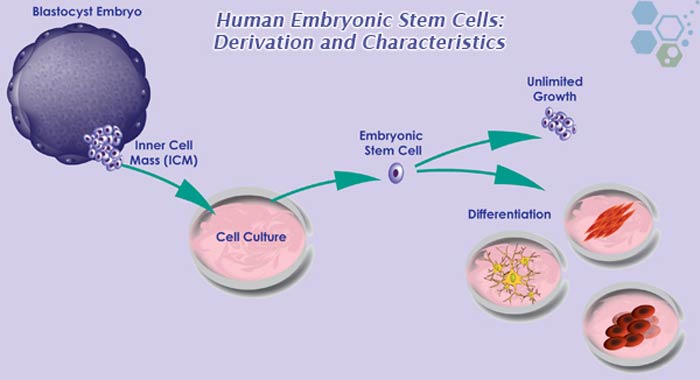
To grow the stem cells scientists remove them from the blastocyst and culture them grow them in a nutrient-rich solution in a Petri dish in the laboratory. They are obtained from human embryos and if the embryo is alive.

The Source Harvesting Procedure Culture And Several Potential Uses Of Download Scientific Diagram
Normally embryonic stem cells have been obtained by growing a human embryo into a cluster of cells that contain an inner cell mass.
. A needle connected to thin flexible tubing will be inserted into a vein in each of your arms. A catheter is placed or an IV lines are placed into veins in each arm and the donors blood is sucked out The stems cells are removed and the blood is returned to the donor in a process called apheresis. Later on in development the cells will become specialized through a process called.
The group says the embryos survived the removal of a blastomere or two. When the embryo is approximately 4 days old the embryonic stem cells are derived from the inner cell mass. Bone marrow Yes.
A somatic cell is simply a body cell that is neither an egg nor a sperm cell. The process begins in telophase. They are harvested during a process called in-vitro fertilization.
Embryonic stem cells are derived from embryos that develop from eggs that were created through the in vitro fertilization process. A harvested embryonic stem cell is placed in a petri dish with nutrients and is allowed to divide. An embryonic stem cell line is obtained when these cells multiply and divide.
The rest of the blood product will be returned to you. - The catheter is placed or IV lines are placed into veins in each armband. Marrow may also be aspirated from the anterior iliac crests and sternum if required.
What Is The Process Used For Harvesting Adult Stem Cells. They are pluripotent and have an unlimited capacity for self-renewal and the ability to differentiate into any somatic cell type. To do this scientists extract some embryonic stem cells from an embryo when it is only a small ball of cells.
The amount required to achieve haematopoiesis is 10-15mlkg of recipient body weight6 Peripheral blood stem cells Through a process of mobilisation haematopoietic. Embryonic stem cells ESCs are cells derived from the inner cell mass of the blastocyst prior to implantation. They are obtained from human embryos and if the embryo is alive this requires the destruction of the embryos.
Bone marrow stem cells are harvested from the donor in an operating room. Here is how the process goes. Blood will be withdrawn from one arm and passed through a machine that separates out the stem cells.
Why Is There Controversy About Using Embryonic Stem Cells. In this technique the nucleus is removed from an unfertilized egg. The nucleus is also removed from the cell of a donor.
Traditionally embryonic stem cells were harvested by destroying the human embryo in a process called. In plant cells the cell plates form a new cell wall. Describe the process used for harvesting embryonic stem cells.
The stem cells divide several times and scientists divide the population into other dishes. This nucleus contains the genetic material. 1 both stem cells 2 a stem cell and a more differentiated cell or 3 both more differentiated cells.
Adult do have stem cells. Therapeutic cloning also called somatic cell nuclear transfer is a technique to create versatile stem cells independent of fertilized eggs. Stem cells are easily retrieved from the bone marrow and peripheral blood.
49 years experience Pathology. Obtaining stem cells from the patient or a donor Blood stem cells are taken through a painless process called apheresis. Feb 2 2019 by Editor in Chief.
Human embryonic stem cells hESCs are pluripotent and their derivation sparked new possibilities from the production of spare parts to treating a plethora of degenerative conditions the study of early embryonic development to revolutionizing drug screening and development and broadening the spectrum of human toxicology research. These eggs are then donated for research purposes with the informed consent of their donors. After several months there.
The cells are placed on a culture plate with nutrients and growth factors. In the past ESCs were cultured with animal material eg mouse fibroblast feeder layers which. Without any signals from the embryo the cells remain pluripotent.
When a stem cell divides the resulting two daughter cells may be. Embryonic stem cells come from human embryos that are three to five days old. Researchers normally create this kind of stem cell line at a more developed stage from the entire mass of embryonic cells.
Stem cells have the ability to self-renew. Embryonic period usually refers to the period that starts with fertilization ultimately ending eight. In animal cells the spindle fibers form a cleavage furrow.
The advances both published online in Nature appear to overcome the key moral objection to the use of ESCs in medicine the fact that the cells can only be obtained by destroying a human. Describe the process used for harvesting embryonic stem cells. Give biblical references that prohibit the harvesting of stem cells from a human embryo.
This can be seen in the image below. Bone marrow Bone marrow is generally harvested from the posterior iliac crest as either an inpatient or outpatient procedure. After this inner cell mass is removed the embryo is ultimately destroyed.
Blood is taken from a vein and circulated through a machine that removes the stem cells and returns remaining blood and plasma back to the patient. All tissue have stem cells. Gen 96 Rom 38.
This involves fertilizing an embryo in a laboratory. Unlike muscle cells blood cells or nerve cellswhich do not normally replicate stem cells may replicate many times. During this process the female is sacrificed and the embryo is destroyed.
The process of transplanting the genetic material from one cell into an euncleated ovum. Researchers do not derive embryonic stem cells from eggs that are fertilized in a womans body. Describe the differences between embryonic stem cells and somatic stem cells.
This forces the stem cells from the bone marrow into the general circulation mobilization. The cytoplasm divides in cytokinesis. Traditionally embryonic stem cells were harvested by destroying the human embryo in a process called somatic cell nuclear transfer SCNT.
It is the inner cell mass that is abundant in the embryonic stem cells.
Human Embryonic Stem Cells Hesc Therapy

Pin On Biomedical Research Stem Cells

Generation Of Human Embryonic Stem Cells A Few Celled Embryo Gives Download Scientific Diagram

Derivation And Use Of Embryonic



0 Comments